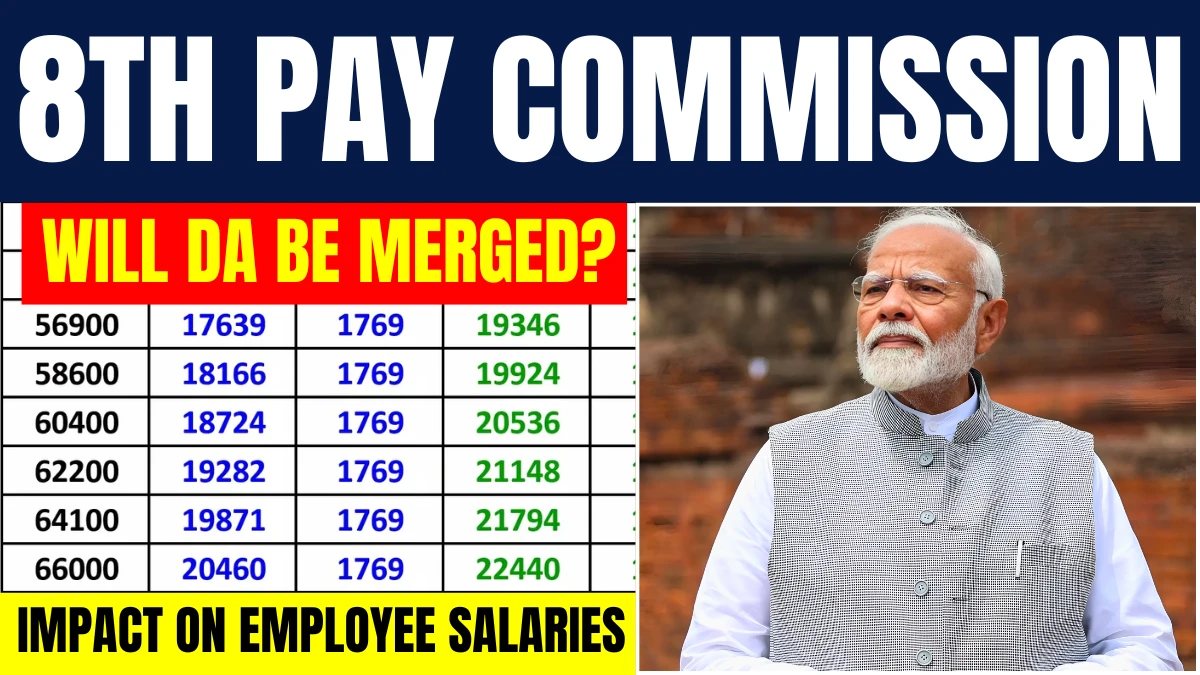
The 8th Pay Commission has become the hottest topic among central government employees and pensioners, driven by strong speculation around a possible Dearness Allowance (DA) merger before the new pay structure is finalized. If the merger happens, it could reset pay matrices, revise pensions upward, and change how future DA hikes are calculated—directly impacting monthly in-hand income and retirement benefits.
| Item | What’s Being Discussed |
|---|---|
| DA Merger | Likely inclusion of accumulated DA into Basic Pay |
| Beneficiaries | Central govt employees and pensioners |
| Pay Impact | Higher Basic Pay, revised allowances |
| Pension Impact | Increased basic pension |
| Timeline | Before or during 8th Pay Commission rollout |
| Objective | Neutralize inflation, simplify pay structure |
What Is DA Merger and Why Does It Matter?
Dearness Allowance is added periodically to offset inflation. A DA merger means the accumulated DA percentage gets integrated into Basic Pay. This raises the base salary, upon which other allowances are calculated. When DA merges, the “starting point” of your pay increases, which can permanently uplift earnings and pensions.
Historically, DA mergers have happened when DA crosses a certain threshold. While no official cut-off is guaranteed, expectations rise as DA climbs over time, making the case stronger for a reset of the pay structure under a new commission.
How the 8th Pay Commission Could Change Your Salary Structure
If a DA merger is approved ahead of the 8th Pay Commission, the merged figure will likely become the new Basic Pay, from which the next fitment factor is applied. This may lead to:
- A higher revised Basic Pay after fitment
- Increased HRA, TA, and other allowance amounts
- Better grade-wise salary progression
- A cleaner pay matrix with lower visible DA but higher base
The real effect depends on the fitment factor, which determines how much your pay rises under the new structure. A higher factor combined with a DA merger could significantly boost monthly income.
What Pensioners Should Expect
Pension calculations are based on Basic Pay, so a DA merger can permanently increase pensions. If DA is merged before the new pay structure, retirees transition to a higher base, lifting the pension floor. This ensures:
- Higher monthly pension
- Improved family pension calculations
- Bigger commutation values
- Better linkage between inflation and pay protection
For older pensioners, this change could be among the most meaningful financial upgrades in years.
Will There Be Arrears After DA Merger?
Whether arrears are paid depends on the effective date set by the government. If the merger is backdated, beneficiaries may receive arrears for the intervening period. If applied prospectively, benefits would start only from the notified date. Either way, in-hand income should rise immediately after implementation.
Single-View Snapshot: Key Pros and Cons
- Raises Basic Pay and Pension permanently
- Improves all allowance calculations
- Reduces dependence on frequent DA hikes
- May compress early-stage increments after reset
- Implementation date decides arrears eligibility
What Are the Biggest Unknowns Right Now?
Several elements remain to be clarified:
- Final decision on whether DA will merge
- The exact DA percentage to be absorbed
- The fitment factor under the 8th Pay Commission
- The effective date and arrears policy
- Rules for retired vs. serving employees
Clarity on these points will decide who benefits the most and how quickly.
How to Prepare as an Employee or Pensioner
Track official announcements, verify pay slips, and keep pension records updated. If the merger happens, it’s wise to:
- Recalculate expected take-home pay
- Review investments and tax planning
- Assess impact on loan eligibility or EMIs
- Update nominations and service records
Being proactive ensures you capitalize on the full benefit when changes roll out.
Conclusion
The expected DA merger linked to the 8th Pay Commission could be a turning point for salaries and pensions. By lifting the Basic Pay, it delivers a lasting upgrade rather than a temporary allowance boost. While the final call, fitment factor, and timelines are awaited, the direction is clear: if approved, the merger will raise incomes, simplify structures, and strengthen retirement security for millions.
Disclaimer
This article is based on publicly discussed expectations, historical patterns, and policy interpretation related to pay commissions and dearness allowance practices in India. It does not confirm any government decision or guarantee timelines, percentages, or effective dates. Final terms will be determined solely by official notifications issued by the competent authorities. Readers are advised to rely on government circulars, gazette notifications, and departmental orders for verified information. The publisher is not responsible for actions taken based on speculative or preliminary details.